Three questions, and Tanner gets back to you either way — including when the answer is no.
The check is free. No obligation. One person, not a call center: Tanner takes the request himself. Rather talk than type? Call or text him: 801-674-0772.
That answer is worth having on its own, and it comes back either way: programs are underwritten on the roof, the usage and a credit check, and none of that is visible from the street or from a brochure.
The check is free. No obligation. Consent isn't required to buy anything.
On SCE's TOU-D-4-9PM residential plan, the price of a kilowatt-hour depends on what time it is used. Off-peak, the same power is about 34¢. Between 4 and 9pm on a summer weekday it can run up to about 58¢. And before anything is switched on, the Base Services Charge is $0.79 a day, about $24 a month.
Source: SCE published TOU-D-4-9PM residential rate plan. Per kilowatt-hour. The Base Services Charge is billed per day.
Think about when a High Desert house actually works hardest. Not at noon. Late afternoon, when the sun has been on the stucco all day and the AC is running flat out. About 23 days a year here hit 100°F or hotter. About 95 hit 90°F or hotter.
On the 4–9pm plan, the hours the AC fights hardest and the hours the power costs most are the same hours. That's the whole game. It's not how much power gets used. It's when.
Temperature figures: NWS/NOAA climate summary for George AFB/Victorville, 46-year period of record.
A $0-down solar and battery program, for homes that qualify, pairs panels with a battery that banks daytime power for the 4–9pm window. The bill you pay now, over the life of the agreement, is the number any program has to beat. Programs are underwritten on the roof, the usage and a credit check, and the programs and their CSLB-licensed contractors are the ones who decide and run the numbers. Three questions at the top of this page is how the asking starts.
The check is free. No obligation. Or call or text Tanner: 801-674-0772.
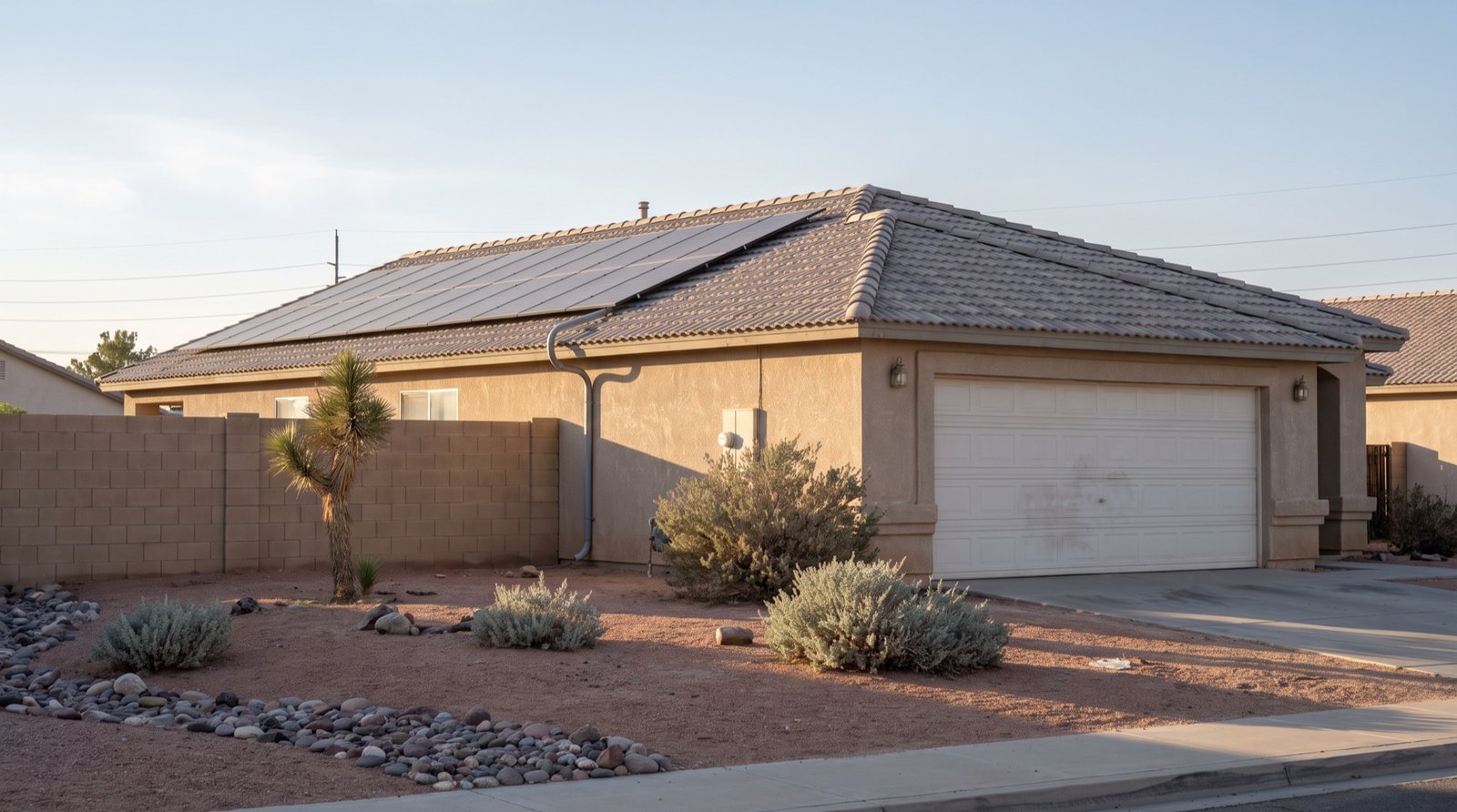
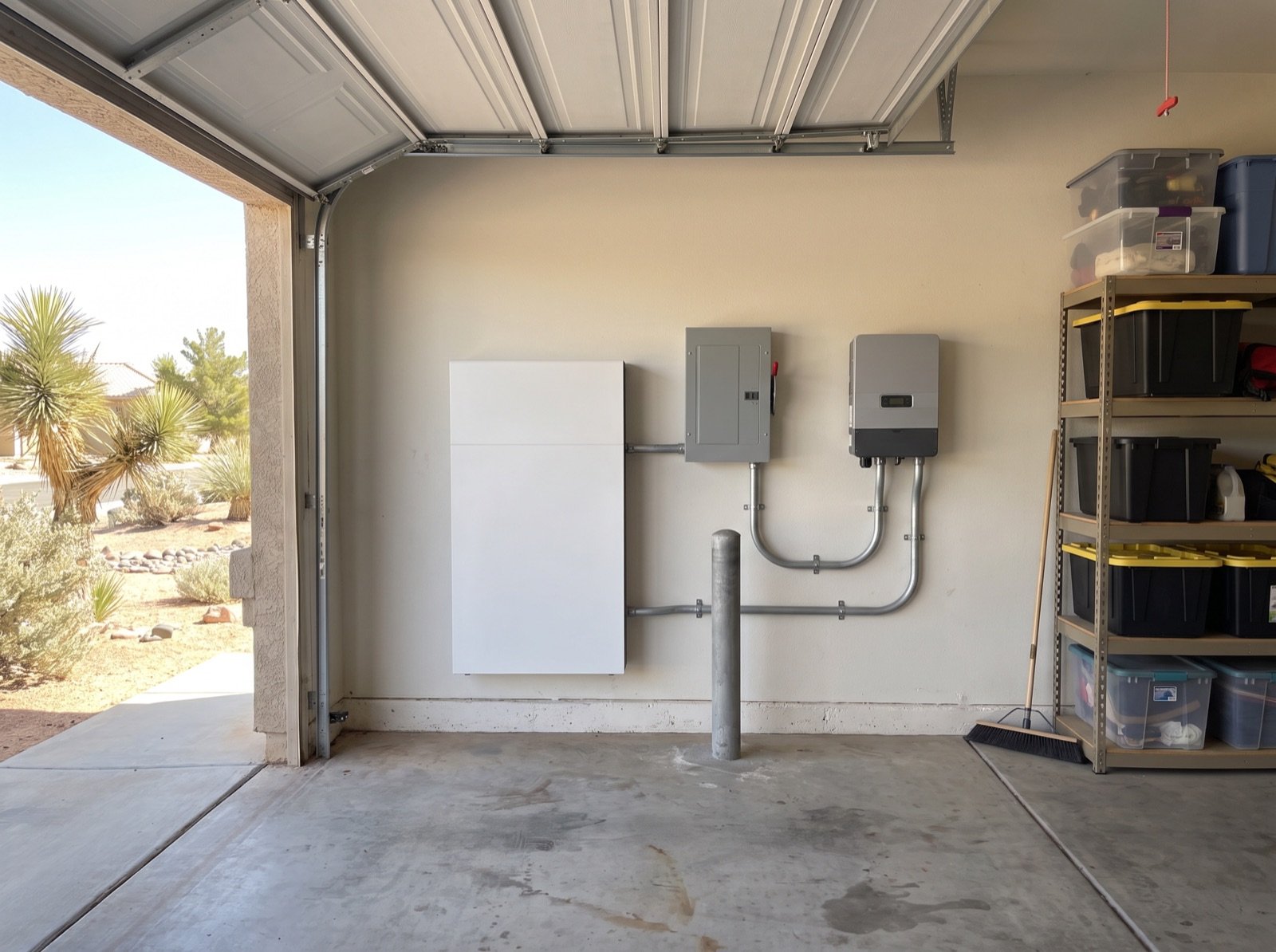
Every image below is a computer-generated illustration. None shows a real home, a real job, a real crew or a real customer. High Desert Solar Guide doesn't install anything; the work is done by independent CSLB-licensed contractors, and every roof is different.


Two things, and one of them is the only thing to decide about today.
Three questions is all it takes to start. Tanner takes the request, looks at your SCE bill with you against the 4–9pm summer rate, and asks the $0-down programs available in the High Desert, for homes that qualify, whether the home is in range, without identifying you. Your details go to a program only if you ask to be connected. The programs and their CSLB-licensed contractors decide whether a home qualifies and run the numbers; Tanner tells you the answer he gets.
A solar company owns and maintains the system on your roof. You pay a fixed monthly amount (lease) or a set rate for the power it produces (PPA), with no money up front for the equipment; site work such as a panel upgrade can be separate. The battery is what covers the 4–9pm window.
A bad deal in a small town costs us more than it makes, so "stay put" is an answer we're happy to give.
Check this one, while it's still the bill on the counter.
Two reasons this bill in particular is the one to ask about.
One: it's the honest test. A program is measured against the hours the AC runs into the 4–9pm window. A mild-month bill flatters everybody and tells you nothing.
Two: the federal picture has already moved once. The homeowner credit, Section 25D, ended for systems whose installation was completed after December 31, 2025. Third-party-owned systems still qualify for a separate credit, Section 48E, claimed by the company that owns the system rather than by the homeowner, and for systems being installed now that generally requires the system to be in service by December 31, 2027. That's why $0-down programs, for homes that qualify, are the main route left for households that no longer qualify for the homeowner credit.
No money up front for the equipment. A solar company owns and maintains the system on your roof, and you pay a fixed monthly amount (lease) or a set rate for the power it produces (PPA). Site work such as a panel upgrade can be separate. Whether that beats what's currently going to SCE is exactly the question the request asks, and it isn't something anyone can answer before looking.
Independent contractors licensed by the California Contractors State License Board. High Desert Solar Guide is a marketing and referral service: we take the request, look at the bill, explain, and connect. We don't build. Verify any contractor at cslb.ca.gov before signing anything. We encourage it.
Three questions, an answer either way, and no fee.
See if my home qualifies for $0-downOr call or text Tanner: 801-674-0772
High Desert Solar Guide is a marketing and referral service, not a construction contractor. All installations are performed by independent contractors licensed by the California Contractors State License Board (CSLB). Verify any license at cslb.ca.gov. Savings depend on usage, utility rates, roof, and program terms; nothing on this page is a guarantee of savings or tax advice. Rate figures: SCE published TOU-D-4-9PM residential rate plan (off-peak ≈34¢/kWh; summer on-peak up to ≈58¢/kWh 4–9pm; Base Services Charge $0.79/day). Temperature figures: NWS/NOAA climate summary for George AFB/Victorville, 46-year period of record. Images on this page are computer-generated illustrations, not photographs of real homes, installations or people.